

For warehouse managers and procurement decision-makers, labor costs represent one of the most significant and fastest-growing line items in operational budgets. In 2026, the global shortage of qualified forklift operators — combined with rising wages, insurance premiums, and shift-coverage challenges — has pushed many logistics operations to the breaking point. The question is no longer whether to automate, but which autonomous forklift solution delivers the fastest return on investment with the lowest deployment friction.
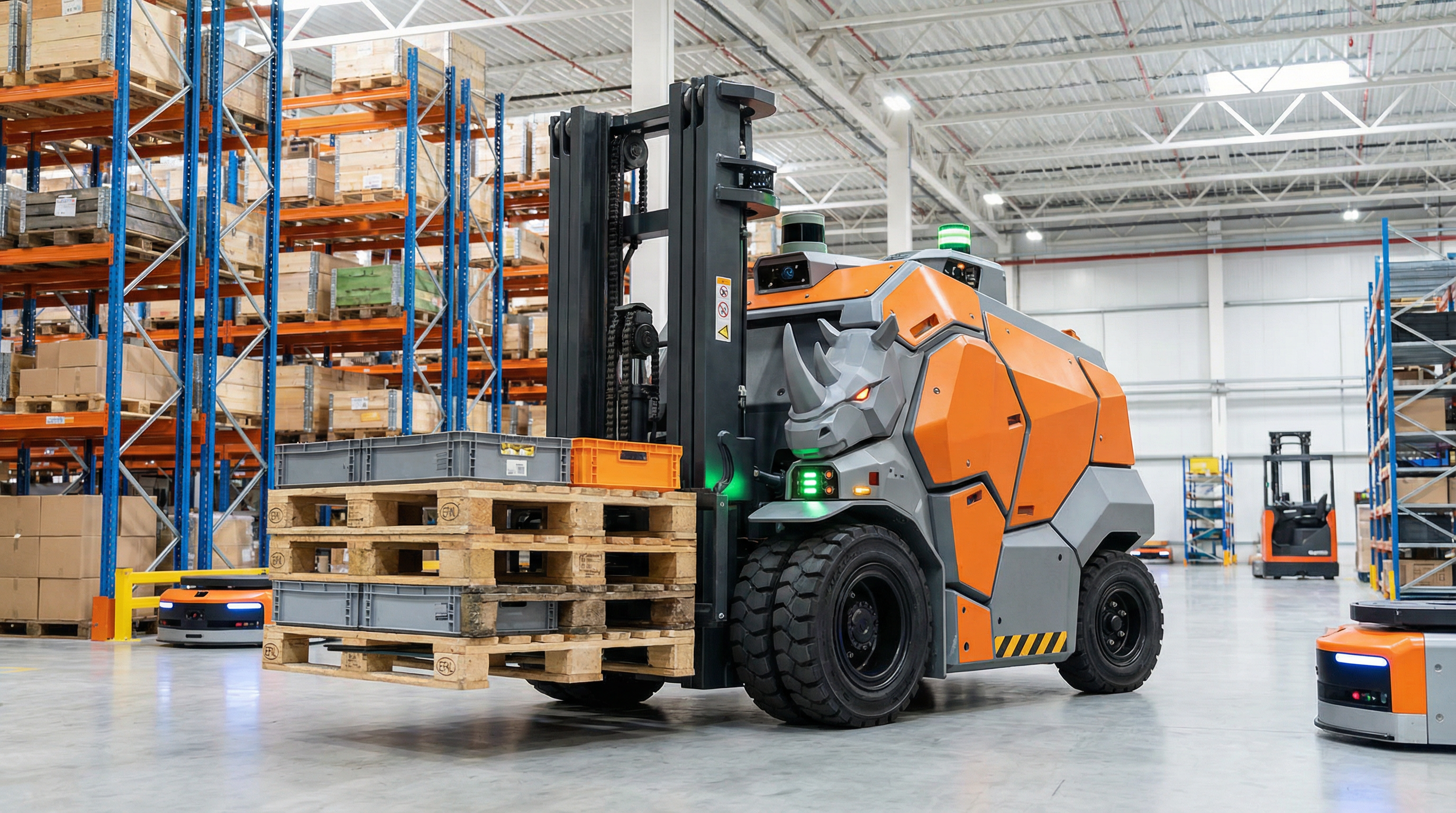
The AI Rhinoceros Autonomous Forklift from airobotmaker is engineered specifically for this challenge. Combining a 1,500 kg payload capacity, 2.5-meter lifting height, and Laser SLAM navigation that requires no floor markings or QR codes, the Rhinoceros offers a compelling case for facilities seeking to replace manual forklift operations with intelligent, cost-effective automation.
The Real Cost of Manual Forklift Operations
Before evaluating any autonomous solution, procurement teams must first quantify the true cost of maintaining a human-operated forklift fleet. The direct costs — operator wages, overtime, benefits, and training — are only part of the picture. Hidden costs include shift coverage gaps, accident-related costs, productivity inconsistency, and high turnover rates.
Human operators require breaks, vacations, and sick days. A single forklift position may require 1.3–1.5 full-time equivalents (FTEs) to maintain continuous coverage. Forklift accidents account for approximately 85 fatalities and nearly 35,000 serious injuries annually in the United States alone, according to OSHA data. Each incident carries direct costs (medical, legal, equipment damage) and indirect costs (downtime, retraining, morale impact). The logistics sector also experiences annual turnover rates exceeding 40% in many markets, creating a perpetual cycle of recruitment and onboarding costs.
When all these factors are aggregated, the total cost of ownership for a single human forklift operator often exceeds $60,000–$80,000 USD per year in developed markets — and is rising.
How the AI Rhinoceros Autonomous Forklift Addresses Each Cost Driver
1. Replacing Multiple Operators with 24/7 Autonomous Operations
The AI Rhinoceros is designed to operate continuously across all three shifts without breaks, vacations, or fatigue-related performance degradation. According to airobotmaker’s operational data, a single Rhinoceros unit can replace at least 3 human operators, delivering immediate labor cost savings that typically allow the system to pay for itself within 12–18 months in high-throughput environments.
The Rhinoceros runs on a 48V battery system with automatic charging capability, meaning the robot can autonomously return to its charging station during low-activity periods and resume operations without human intervention. This eliminates the battery-swap downtime that plagues many competing autonomous guided vehicle (AGV) systems.
2. Laser SLAM Navigation: No Infrastructure Investment Required
One of the most significant hidden costs in autonomous forklift deployment is infrastructure modification. Many legacy AGV systems require the installation of magnetic strips, reflective tape, QR code grids, or dedicated lanes — investments that can add $50,000–$200,000 to a deployment project and require facility shutdowns during installation.
The AI Rhinoceros uses Laser SLAM (Simultaneous Localization and Mapping) navigation, which builds and updates a real-time map of the warehouse environment using a 60-meter single-line LiDAR sensor. This means no floor markings or infrastructure changes are required, the robot can be operational within days, and it dynamically reroutes around obstacles, personnel, and changing inventory layouts. Coverage extends up to 40,000 square meters of navigational mapping area. For facilities with 1.6-meter narrow aisles — common in high-density racking configurations — the Rhinoceros’s compact turning radius of 1,500mm and body width of 950mm enable full operational access without aisle reconfiguration.
3. Intelligent Obstacle Avoidance: Reducing Accident Costs to Near Zero
The Rhinoceros is equipped with dual 3D cameras and LiDAR sensors that provide 360-degree environmental awareness. This multi-sensor fusion approach achieves a 99.6% collision prevention rate, dramatically reducing the risk of product damage, equipment damage, and personnel injury that represent major cost centers in manual forklift operations.
The system’s obstacle avoidance is not merely reactive — it is predictive. When the robot detects a potential obstruction in its path, it calculates alternative routes in real time, maintaining throughput while ensuring safety. This capability is particularly valuable in dynamic warehouse environments where foot traffic, temporary storage, and changing inventory positions create constantly shifting hazard profiles.
4. Real-Time Fleet Analytics: Boosting Utilization by 30%+
Labor cost reduction is only one dimension of the Rhinoceros’s value proposition. The robot’s centralized fleet management system provides real-time analytics on utilization rates, task completion times, battery status, and route efficiency across the entire autonomous fleet. According to airobotmaker’s deployment data, facilities using the Rhinoceros fleet management platform achieve at least 30% improvement in fleet utilization compared to manually-managed forklift operations.
Technical Specifications: What Procurement Teams Need to Know
The AI Rhinoceros Autonomous Forklift (Model: RBOT30F) is built on a robust mechanical platform. Key specifications include a maximum load capacity of 1,500 kg, fork lifting height of 2,585 mm, maximum gantry height of 3,050 mm, body dimensions of 1,950 × 950 × 1,900 mm, turning radius of 1,500 mm, travel speed of 4 km/h (full load) and 5.6 km/h (no load), drive motor power of 0.8 kW, lifting motor power of 2.2 kW, 48V battery with automatic charging, noise level below 70 dB(A), Laser SLAM navigation with 60m LiDAR, and 40,000 m² mapping coverage.

ROI Calculation: A Practical Framework for Decision-Makers
For procurement teams building a business case for autonomous forklift investment, the following framework provides a structured approach to ROI calculation. Each Rhinoceros unit replaces approximately 3 operators, with an average annual cost per operator (wages, benefits, overhead) of approximately $65,000, yielding annual savings of $195,000 per unit. Additional productivity gains from 30%+ utilization improvement and near-elimination of accident costs further strengthen the business case. With no infrastructure modification required and rapid deployment timelines of days to weeks, the typical payback period is 12–18 months for high-throughput facilities and 18–24 months for medium-throughput operations.
Deployment Considerations: Is the AI Rhinoceros Right for Your Facility?
The Rhinoceros is optimally suited for cold storage and pharmaceutical warehouses where human operators face health and comfort challenges during extended shifts, high-bay warehouses requiring consistent 2.5-meter stacking heights with 1,500 kg payloads, multi-shift operations where 24/7 coverage is required but staffing is difficult, large-area facilities (up to 40,000 m²) with complex layouts and narrow aisles, and facilities with existing WMS/MES infrastructure seeking seamless integration via open SDK.
Conclusion
The AI Rhinoceros Autonomous Forklift represents a mature, production-ready solution for warehouse operators seeking to reduce labor costs, improve safety, and increase operational efficiency in 2026. With a 1,500 kg payload, 2.5-meter lifting height, Laser SLAM navigation, and proven ability to replace three or more human operators per unit, the Rhinoceros delivers a compelling ROI that typically pays back within 12–24 months.
For procurement decision-makers evaluating autonomous forklift options, the combination of zero infrastructure investment, rapid deployment, and real-time fleet analytics makes the AI Rhinoceros Autonomous Forklift a strong candidate for facilities of all sizes. To learn more or request a free trial, visit airobotmaker.com/rhinoceros.